
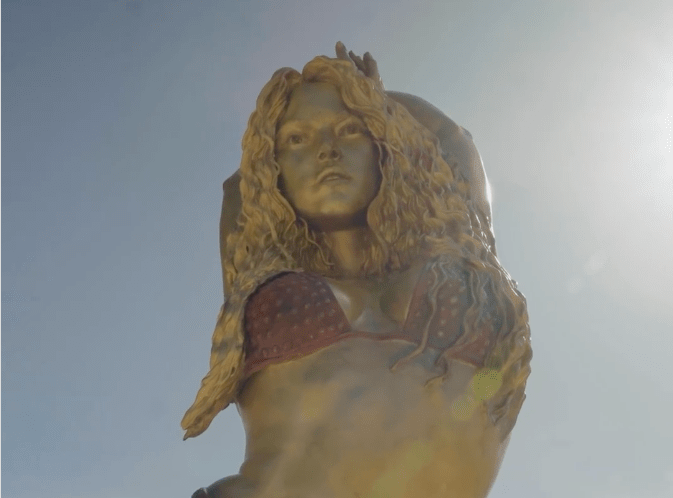
Ojos Así: Shakira and Fused Identity
Master’s thesis
On February 2, 2020, Shakira Isabel Mebarak Ripol performed on stage at the National Football League’s LIV Super Bowl. Her fusion of Lebanese, Colombian, and African music and dance sparked outrage and jubilation among viewers. While some insisted her dance was proof of dangerous, subaltern hypersexuality, others argued it was evidence of Latinidad’s thrivance in spite of ongoing colonization and U.S. imperialism. Still other audience members argued her use of African and hip-hop styles occupied space in a long history of white and Latine appropriation of Black cultural artifacts. Disparate audience members then aired disagreements via the internet. Shakira’s performance and subsequent audience responses provide rich material for analyzing how differently situated audience members decode visual culture texts produced by racialized women whose identities refuse simplistic racial categorization. I argue dominant- hegemonic viewers attempt to bolster existing power structures by disciplining Shakira’s body via decoding strategies that reproduce white supremacy. Through cross-cultural, networked socialities, subalternized, diasporic audience members emphasize interpretations that directly contradict dominant-hegemonic interpretations. By doing so, they disrupt dominant-hegemonic control over encoding and decoding strategies, subverting white supremacy.
Resisting Transhistorical Violence: Fringe and Art Activism
Between 1587 and 1589, Netherlandish artist Jan van der Straet engraved a series of plates entitled New Inventions of Modern Times. One, Allegory of America, portrays an Indigenous woman in a feathered headdress and skirt eagerly welcoming Florentine explorer Amerigo Vespucci as he steps onto land. Van der Straet’s work occupies space in a long history of male European artistic depictions of Indigenous women, but the white colonial gaze evident in Allegory has not gone unchallenged. In 2007, Rebecca Belmore (Anishinaabe) responded to transhistorical violence against Indigenous women and girls with a billboard instalment entitled Fringe. Although originally displayed as a direct response to the Pickton murders in Vancouver, Fringe transcends a single event or story. Belmore’s billboard reimagines controlling images that construct Indigenous women as sexually available conquests. She strips the image of the icons that artists have used to represent Indigenous women. By placing the billboard in a crowded metropolitan area, Belmore forces the viewer to confront the still-present reality of Indigeneity alongside the concomitant brutality of settler colonialism. Belmore’s art functions on multiple levels to convey a sense of survivance in the face of systemic attempted genocide. Fringe is a fully realised, modern, and powerful piece of art activism that transforms visual culture. In this paper, I analyse the transhistorical effects of art as a tool of colonisation, as seen in van der Straet’s work. I then theorise Fringe as a vibrant piece of art activism (artivism) that subverts the white male colonial gaze.
Ratchet Feminism on TikTok: Visual Culture Resistance to Oppression published on hcommons.org for the Global Digital Humanities Symposium 2023
Abstract: Digital visual culture in cyberspace creates new methods for Black queer women to resist the oppression of controlling images. As cyborg beings, Black queer women perform their identities in creative and boundary-breaking ways, often using sexually explicit lyrics and dance to resist white normativity and heteronormativity. Multinational social media platforms like TikTok provide readily accessible platforms for Black queer women to extend the reach of their performances. TikTok also perpetuates oppression by monetizing Black sexuality. ByteDance, TikTok’s parent company, has experienced a doubling of profits in the past year. Users themselves often seek to capitalize on their performances. Some theorists insist that the commodification of Black sexuality perpetuates Black subjectification. Not all theorists agree, though. Some assert that performing identities in excess of the controlling images allows oppressed people to survive within the ideologies that oppress them. Additionally, the performances create a counter discourse in the midst of oppression, undermining oppressive ideologies from the inside. Sometimes labeled “ratchet feminism,” young Black queer musicians confront respectability politics, often putting them into ideological conflict with well-respected Black feminists like bell hooks and Patricia Hill Collins. Using TikTok content creator Thee King Kitty as a case study, this paper analyzes the performance of Black queer sexuality through ratchet feminism as brown jouissance, disidentification, and subversion. Using both quantitative and qualitative data, the research explores the nuanced interactions of Black feminism in digital visual culture. I hypothesize that identity performance on TikTok specifically and in cyberspace generally acts as a form of resistance that speaks to the lived experiences and needs of Gen Z and Millennials. Through these acts of resistance, youth form solidarities that undermine controlling images and systems of oppression.

 Bryn Brody